Explainer
What Is a Geodesic Dome? The Engineering Behind the Ultimate Event Structure
A geodesic dome is a spherical structure built from a network of triangles — and that one geometric decision explains everything people love about them: the impossible-looking strength, the wide-open interior, and the way a crowd goes quiet when they step inside one.
A short history: from planetarium to counterculture to main stage
The first true geodesic structure was engineered in 1926 by Walther Bauersfeld — a planetarium dome for Carl Zeiss in Jena, Germany. But the idea found its prophet two decades later in R. Buckminster Fuller, the American inventor who patented the geodesic dome in 1954 and spent his life arguing it was the most efficient shelter humans had ever devised. Fuller's domes housed radar stations in the Arctic, the U.S. pavilion at Expo 67 in Montreal, and eventually the geodesic idea escaped architecture entirely — the carbon molecule C60 was named the "buckminsterfullerene" because it shares the dome's geometry.
The counterculture adopted domes in the 1970s; festivals inherited them from the counterculture; and today the geodesic dome has become the signature silhouette of experiential events — from Burning Man's deep playa to the biggest brand activations in the world.
Why triangles beat everything
A triangle is the only polygon that cannot change shape without changing the length of a side. Build a sphere out of them and any force applied anywhere — wind, weight, a climbing rigger — is distributed across the entire network. The result is the highest strength-to-weight ratio of any large structure: a dome strong enough for desert windstorms that still packs onto a truck and builds in hours.
That geometry also eliminates the event planner's oldest enemy: interior poles. A dome is self-supporting, so a 50-foot span is one uninterrupted room — clear sightlines for every seat, full flexibility for staging, and a ceiling that photographs like architecture instead of like rental equipment.
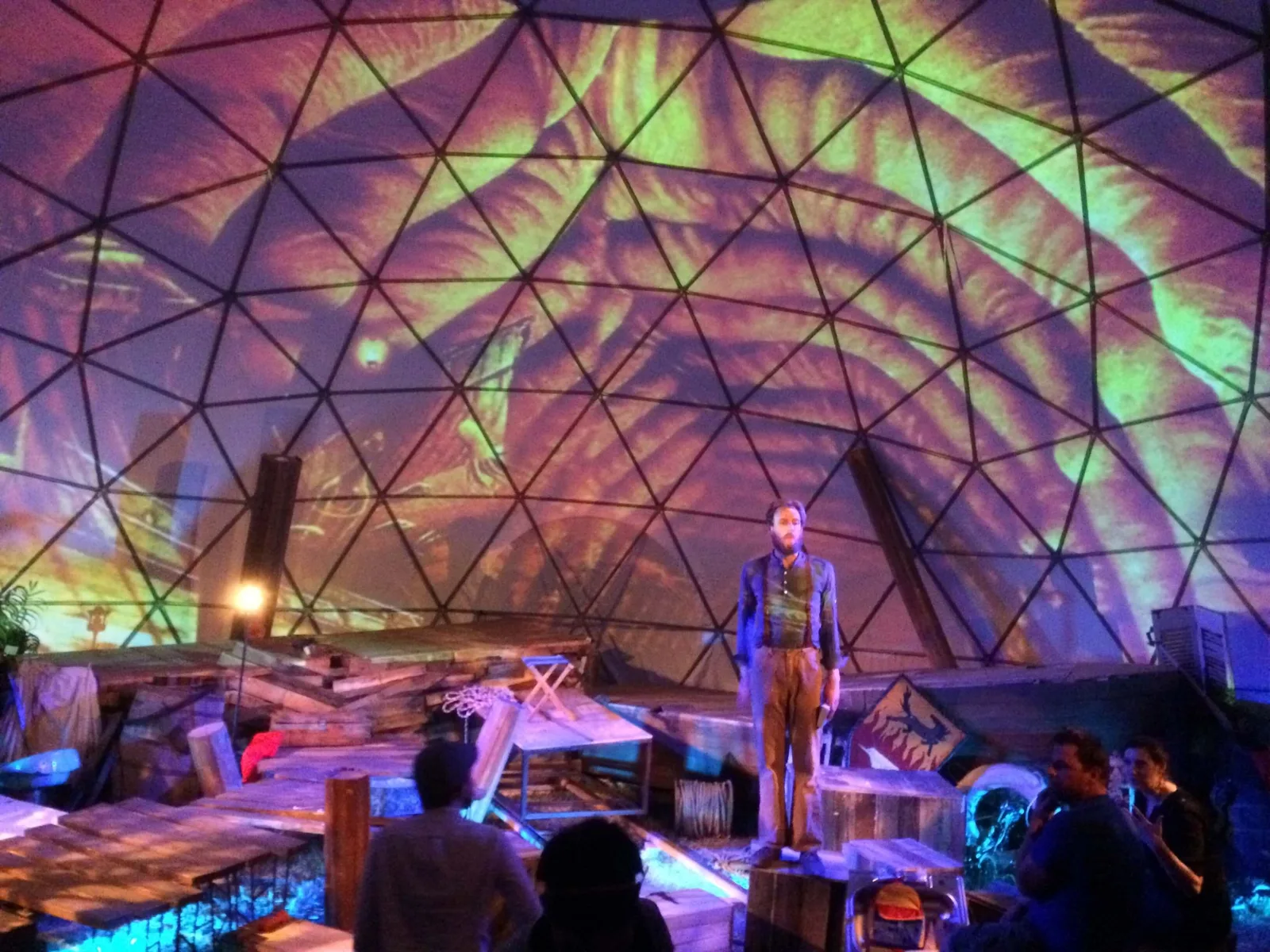
The projection superpower
There is a reason planetariums have always been domes. A curved interior surface wraps the audience's entire field of view with no corners, no seams, and no screen edge to break the spell. Modern projection mapping turns that same geometry into fully immersive 360° environments — film, generative art, product worlds — where the audience isn't watching the content, they're standing inside it. It's the closest physical experience to virtual reality that doesn't require a headset, and it's become the fastest-growing use of our dome fleet.
Domes at events: what the geometry buys you
- Presence: a dome is landmark-shaped. On a festival ground or a trade-show floor, it's the structure people photograph and navigate by.
- Acoustics: the curved shell creates a warm, contained sound field — our Burning Man builds are as famous for how they sound as how they look.
- Total customization: covers run from blackout (projection-ready) to printed brand skins to fully transparent domes that disappear against the sky.
- Speed: engineered kits build in hours, not weeks — a 20-foot dome in about 4 hours, even our 120-foot flagship in just over a day.
See the geometry in person
We deploy geodesic event domes from Southern California to anywhere in the world — nine standard sizes from 20 to 120 feet, detailed with true-to-scale visuals on our dome sizes page. If Fuller was right that the dome is the most efficient structure humans build, an event is the most fun place to prove it. Tell us what you're planning.
Frequently asked questions
Who invented the geodesic dome?
The geometry was first engineered by Walther Bauersfeld for a planetarium in 1926, but Buckminster Fuller developed, patented and popularized the geodesic dome in the late 1940s, turning it into an architectural movement.
Why are geodesic domes so strong?
The structure distributes load across a network of triangles — the only shape that cannot deform without changing the length of its sides. Stress spreads through the whole framework, giving domes the highest strength-to-weight ratio of any large structure.
Why are domes ideal for projection mapping?
A dome interior is a continuous curved surface that wraps the audience’s entire field of view. Projected content has no corners or seams to break the illusion, which is why planetariums — and modern immersive experiences — use domes.
Are geodesic event domes weatherproof?
Yes — engineered event domes are rated for wind and weather that would ground ordinary tents. The self-supporting frame needs no center poles or guy-wire forest, and covers range from blackout vinyl to transparent skins.
Let's talk
Ready to put your event under the dome?
Substantial inventory ready for immediate deployment — or a fully custom branded build with a 360° projection environment. Either way, we move fast.
Start Your Project